
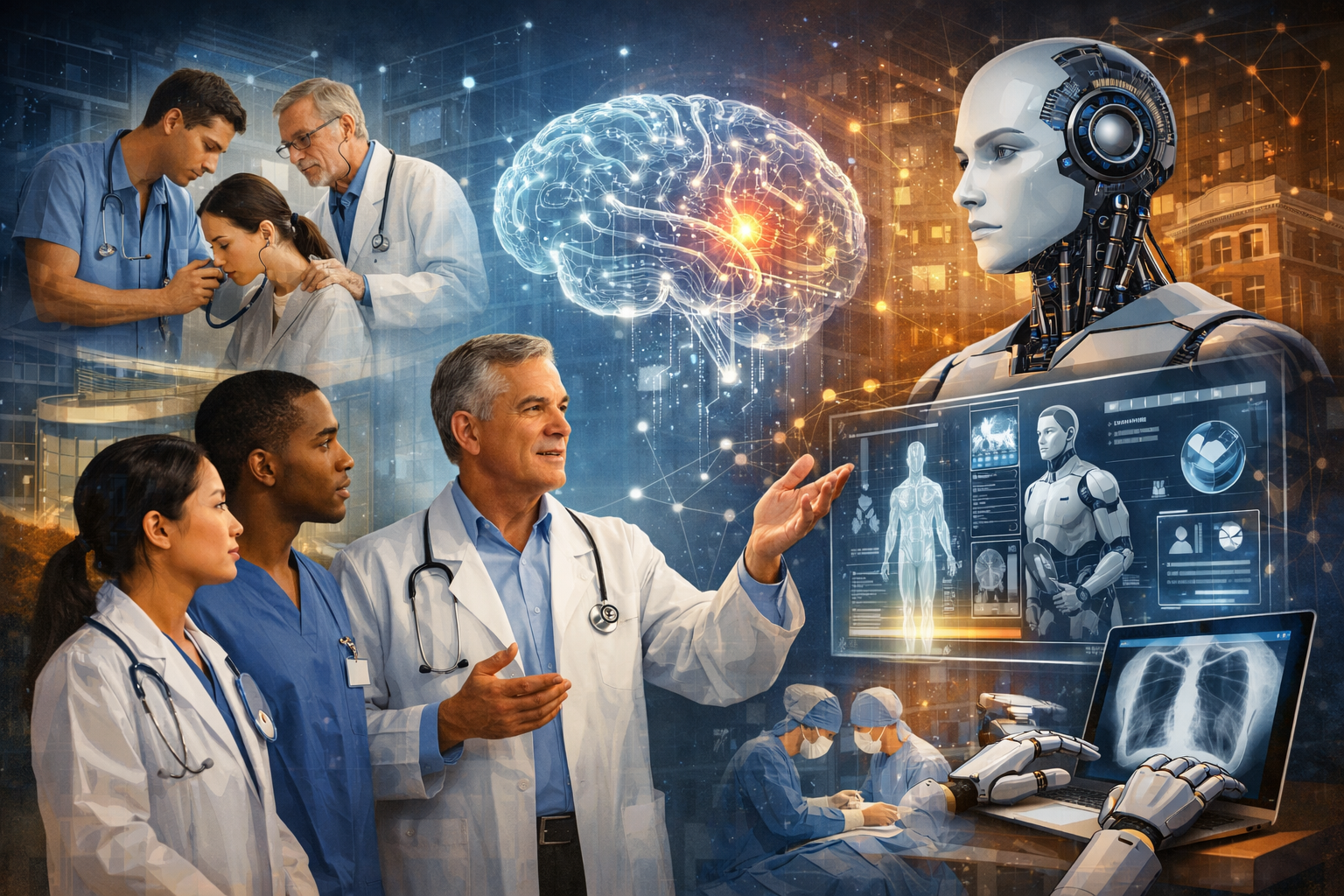
Medical educators from the Society of General Internal Medicine published a position paper in 2026 outlining a framework to integrate artificial intelligence (AI) into clinical training without compromising vital physician competencies. The guidance addresses risks posed by rapid adoption of large language models since 2022, identifying three trainee hazards: never-skilling (bypassing foundational clinical reasoning), de-skilling (loss of skills from overreliance on automation), and mis-skilling (internalizing flawed algorithmic outputs).
The authors propose a three-tier taxonomy categorizing clinical tasks by automation suitability: low-risk administrative duties suitable for automation; hybrid tasks requiring active human oversight of AI outputs; and high-risk encounters demanding human-only judgment due to complexity and ethical considerations. They recommend formal competency thresholds before trainees access AI tools, cognitive safeguards like think-first exercises, and mentorship modeling critical engagement with AI.
The paper highlights AI’s potential to personalize education through precision analytics but emphasizes that human mentorship remains essential for professional identity and ethical judgment. Assessment methods should evolve to evaluate diagnostic reasoning and metacognition. It also calls for transparency and safety evaluations of AI platforms before clinical use, and mechanisms to report AI-related errors.
By redirecting time saved through automation toward uniquely human skills such as Bayesian reasoning, physical examination, and empathetic communication, the framework aims to prepare physicians for an AI-augmented future.